Our Office is tasked with reconciling EDII constructs and policies with the barriers that impact the daily lives of equity deserving members of our science community. We can make progress in this task by harnessing the current considerable momentum within our Faculty, engaging with EDII student, staff and faculty leaders and committees within our Departments, Schools and units, collaborating with EDII offices and initiatives outside the Faculty and considering science-specific, progressive policies and strategic initiatives.
Current Actions
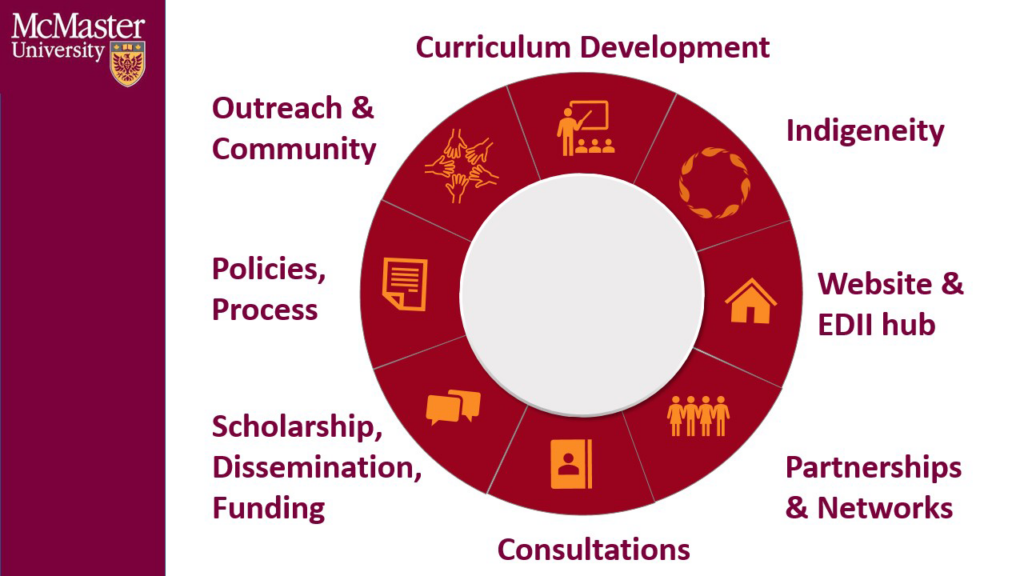
Unveiling of art by queer, interdisciplinary Anishinaabe (Algonquin) artist, facilitator and member of Timiskaming First Nation Natalie King in the Burke Science Building (project led by students Sage Hartmann, Brooke Fearns, Alisha Sharma and project coordinator, Maggie Cockburn)
Participate in and support Indigenous Student Services Gaodadeihwahni:ya:s Transition Program
Participate in STEAM Think Tanks organized by the Indigenous Education Council
Developing partnership with Indigenous Student Services for outreach initiatives
Support and participate in collaborative grants with Indigenous scholars
Include courses from the Department of Indigenous Studies in the Anti-Racism Inclusion and Equity (ARIE) in science certificate
Future Plans
With the Associate Dean (Academic), participate in discussions and grant application to find interfaces and interactions of Indigenous scholars, community Knowledge Holders with members of the Faculty of Science
Continue to work together and honour the commitments made to advance Indigenous priorities in all activities including teaching and research in the Faculty of Science
Intentional engagement between and within EDII committees, practitioners and leaders from student groups, academic units, administrative offices within the Faculty of Science, and with central units involved in EDII work
Fora (e.g. Science EDII Leadership Network meetings), and platforms (e.g. Science EDII Leadership Network MS Team; @mcmastersciedii, AD EDII website) for sharing best practices and resources
Listening tours and regular updates of activities from the Office of the AD EDII
Sharing EDII frameworks, approaches and best practices between Faculties
Increased awareness of and participation in national organisations (e.g. Canadian Association for the Prevention of Discrimination and Harassment in Higher Education)
Continue to create connections and foster engagement with EDII/EDIA practitioners, committees and leaders across campus including through the Equity and Inclusion Office
Increase awareness of and participation in central equity-centred initiatives (including but not limited to the President’s Advisory Committee on Building an Inclusive Committee, African-Caribbean Faculty Association of McMaster University, Latin American Network at McMaster University, Accessibility Hub, Office of Community Engagement)
Increase awareness and participation in community groups and organisations
Current actions
Co-develop undergraduate curricular content that examines themes of social justice, equity, anti-racism and anti-oppression in the context of science disciplines (SCIENCE 2AR3, SCIENCE 4AR6)
Enable inter-Faculty interactions by cross-listing relevant courses including through the Anti-racism, Inclusion and Equity in Science (ARIE) concurrent certificate, which was established in 2025 and is open to all undergraduate students at McMaster.
Engage with the Paul R. MacPherson Institute for Leadership, Innovation and Excellence in Teaching, and specifically, their Educational Developer in Anti-Racist Pedagogies to develop curricular content.
Coordinate EDIA module for graduate students (e.g. in CHEM 700 Tools for the Chemical Profession course)
Future Pans
Sustain and build curricular content, and find mechanisms to secure teaching resources and supports
Develop resources and courses for graduate students
Participate in and support community of practice to integrate EDIA into the curriculum
Initiate, collaborate with and promote unit-specific, Faculty-wide and campus-wide events and initiatives
Engage through regular meetings with student leadership (e.g. Science Graduate Student Association, McMaster Science Society) and student success groups (e.g. Black Student Success Centre, Latin American Network at McMaster University, Women In Science and Engineering Initiative) to promote awareness and exchange
Provide, support and promote opportunities for training and awareness (e.g. Employment Equity Facilitator training, research/scholarship/grant workshops)
Future plans
Continue to develop electronic repositories of resources including literature, reports, websites, online training and courses
Identify and support opportunities for role-specific training for students, staff and faculty members
Identify and support opportunities for training for staff and faculty members to support students from equity deserving groups
Create and foster opportunities for healing, dialogue and informed discussion while respecting impact on community members.
Consultations
Continue Faculty-wide, free outreach programme – McMaster Equitable Pathways to Learning University Sciences (MePLUS) – for Black, Indigenous, Latinxidentifying high school students bringing together students, staff and faculty members (four-fold increase in participants from Yr. 1 to Yr. 2)
Partner with other Faculties (e.g. Engineering, Health Sciences), student success centres (e.g. Black Student Success Centre, Latin American Network at McMaster University, Indigenous Student Services) and outreach programs (e.g. Mac i-STEP, Black Outreach STEM Series) and McMaster’s Access Program in outreach activities (>2000 participants).
Engage with community (vendors, school boards, community partners, families)
Support McMaster student group-led outreach initiatives
Consult in equitable admissions initiatives (e.g. iSci, Arts & Sci.), promotion of
Student opportunities (e.g. NSERC USRA)
Seek collaboration and partnerships with community groups
Engage in, support and amplify EDIA-based scholarship: support, celebrate and build capacity for research, which examines science from the perspective of equity.
Disseminate: support and participate in opportunities to gather, write, speak and invite scrutiny and feedback about EDIA work
Participate and provide EDII-centred feedback and perspectives in committees and processes in the Faculty of Science that includes all Associate Deans (as articulated in Faculty of Science By-Laws)
Participate as EDII consultant, Faculty of Science Tenure and Promotion Committee, and Research Excellence, Awards, Prizes, and Rankings Committee
Participate in faculty search processes including meeting with and providing reports on short listed candidates
Serve as liaison with HR and provides support to Employment Equity Facilitator
Participate in IQAP processes including in reviewer selection, feedback on unit reports/response to reviewer
Serve as member in Provost Data Working group, collaborate with the Office of Institutional Research and Analysis and contribute to best practices framework for stewardship of identity-based data
Seek access to disaggregated data including datasets collected by the Ontario Universities’ Applicant Centre by providing use case documents and completing Freedom of Information and Protection of Privacy Act requests.
Serve and provide EDIA-centred feedback and guidance on search processes, grant applications and committees (internal and external)
Provide feedback to refine ongoing processes and policies
We will work to facilitate coordination and collaboration with McMaster’s strong EDI scaffolding comprising the Equity and Inclusion Office (EIO), the Employment Equity Facilitator program, and organizations such as African and Caribbean Faculty Associate of McMaster (ACFAM) and President’s Advisory Committee on Building an Inclusive Community (PACBIC). At the same time, we plan to engage, connect and collaborate with our Indigenous scholars and students, and find pathways to implement the guidance provided in the Indigenous Strategic Directions by the Indigenous Education Council (IEC) and McMaster Indigenous Research Institute (MIRI).
Please join us by sharing your thoughts, vision, suggestions and time. Please contact us at adediisc@mcmaster.ca.